

Would I recommend it? Absolutely.
After eighteen years working with leadership teams across finance, commercial and data, I have seen countless strategic plans. Most were well thought through, yet many never delivered the results they promised. Not because the strategy was wrong, but because execution is hard.
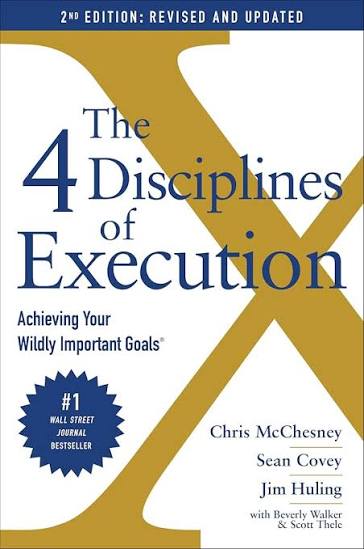
That is exactly why The 4 Disciplines of Execution (4DX) resonated with me.
The book is built around a simple but powerful observation: organisations don't fail because they lack ambition; they struggle because the urgency of today's work crowds out the work that creates tomorrow. The authors describe this as the "whirlwind", and it is a concept that immediately felt familiar.
In my experience, leadership teams rarely struggle to identify opportunities. The real challenge is deciding which opportunities deserve their limited time, attention and energy.
Four disciplines, one purpose
The strength of 4DX is not that it introduces complicated management theory, quite the opposite. It offers four practical disciplines that help organisations keep their focus on what matters most.
The first discipline
The first discipline, Focus on the Wildly Important, stood out to me most.
Every organisation has more opportunities than it has capacity. New priorities are constantly emerging, each with a compelling reason to exist, and yet, every new priority competes with an existing one. One of the biggest lessons I have learned is that leadership is often less about deciding what to do, and more about deciding what not to do. This discipline captures that reality particularly well.
The second discipline
The second discipline, Act on Lead Measures, shifts the focus from measuring results to measuring the activities that influence those results.
Most organisations monitor lag measures such as revenue, profit or customer satisfaction. These are important, but by the time they move, there is little opportunity to influence them. Lead measures ask a different question: Are we consistently doing the things that make success more likely? For me, this is where leadership conversations become far more valuable as the focus shifts from explaining yesterday's performance to improving tomorrow’s performance.
The third discipline
The third discipline, Keep a Compelling Scoreboard, is equally practical. Too often I see dashboards containing an abundance of information but very little clarity. Measures should encourage action, not simply reporting, because people engage differently when they can clearly see whether they are making progress. Translated: a good scoreboard should not be another management report, it should help the team quickly answer one simple question: Are we winning?
The fourth discipline
Finally, Create a Cadence of Accountability provides the rhythm that keeps execution alive.
Rather than relying on lengthy steering committees or quarterly reviews, the authors advocate short, regular conversations where teams make commitments, review progress and remove obstacles. I would agree that these consistent habits often achieve more than complex governance processes.
What resounded with me
What I appreciated most about this book is its recognition that execution is fundamentally a behavioural challenge. Throughout my career, when organisations have struggled to execute, the problem has rarely been a lack of intelligence or commitment. More often, I have seen the same patterns emerge:
-
- too many competing priorities;
- unclear ownership;
- measures that monitor performance but do little to influence behaviour;
- meetings that report rather than enable decisions; and
- no consistent rhythm that maintains momentum.
These are not problems that another strategic planning session will solve, they are problems that require leadership, focus and clarity.
My Energy Perspective
Reading The 4 Disciplines of Execution reinforced something I have come to believe over the years: organisations often don't struggle because strategy is weak, more often, they struggle because execution loses focus.
Most leadership teams don't lack ambition. In reality, they lack the capacity to pursue every opportunity at once because time, attention and energy are finite resources. Every new priority competes with an existing one, yet we rarely stop to ask what we are willing to let go of. That is why the first discipline, focusing on what is wildly important, stands out to me. Not because it is easy, but because it requires leadership to make difficult choices. Saying no is often more valuable than saying yes.
The book also reminded me that execution is ultimately about people. Clear priorities, visible progress and regular accountability create momentum because they change behaviour, not because they introduce another management framework.
That aligns closely with my thinking. I believe organisations release potential when people understand what matters most, know how they contribute, and have the clarity and rhythm to turn strategy into meaningful action.
A final reflection
Today, many organisations still question whether remote or hybrid working really works and I believe that is often the wrong question. The better question is:
How clear are we about what we are trying to achieve, who is responsible, and how we support each other in getting there?
Because remote working does not create culture problems, it reveals them. That may sound uncomfortable, but it is also good news, because it means the solution is usually much closer than we think.
